

Here’s why electric car sales are plummeting in Georgia
Reprinted here is the entire story written by AJC staff writer Chris Joyner published on line on January 13th and in newsprint on January 16, 2017. Copyrighted material – Atlanta Journal Constitution.
Here’s a fact maybe not generally appreciated by commuters gazing at Atlanta’s smudgy, smoggy skyline: Georgia has the second most electric vehicles in the nation.
Here’s another fact: Not for long.
Georgia has about 25,000 electric cars on the road, mostly in metro Atlanta and largely funded by what was one of the most generous state tax incentives in the nation — a $5,000 state income tax credit. But state lawmakers, many of them conservatives who are predisposed against consumer tax credits anyway, canceled the credit in 2015 and installed a $200 registration fee instead.
That whipsaw effect pushed new electric vehicle purchases off a cliff. In July 2015, the state registered 1,426 electric vehicles purchased as the tax credit expired. The next month, just 242 were registered — that’s an 83 percent drop and sales have not rebounded.
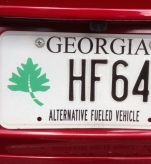
The impact also can be seen in the decline of specialty license plate sales for alternative fuel vehicles, which are tied to the registration fee. Every all-electric vehicle — as well as some other alternative fuel vehicles — is subject to a $200 fee. Owner of such cars can opt to get the specialty license plate in return, giving them access to Atlanta’s HOV lanes.
However, since the change in state policy, monthly license plate sales are down nearly 60 percent.
“We should be around 40,000 vehicles now,” said Jeff Cohen, founder of the Atlanta Electric Vehicle Development Coalition. “We’re not growing.”
Backers of alternative fuel vehicles like Cohen have complained that lawmakers turned one of the friendliest states to the electric car into one of the least hospitable.
“According to the Georgia Department of Revenue, sales and leases have dropped over 90 percent,” said Public Service Commissioner Tim Echols, a proponent of the tax credit and owner of two electric cars. “The tax credit was key to our growing this market.”
No one disagrees with that, but it made some conservative lawmakers uncomfortable. Sen. Butch Miller, R-Gainesville, served on a special joint study committee created last year to look into alternative fuel vehicles and said the dramatic decline shows the tax credit only propped up an industry that didn’t have wide consumer support.
“Our previous electric car tax credit was too generous, too rich. We have to strike a balance on what is good for the economy, what’s good for the environment and what’s good for the consumer,” said Miller. “It should be market driven, and a free-market approach answers a lot of questions.”
Credit not likely to be revived
Attempts last year to reinstate a version of the tax credit failed, and the joint study committee met three times last year and issued no recommendations. And Miller made it clear the committee was taking a wait-and-see approach to any new measures.
“At this point it’s really fluid because we are still working on trying to develop the right kind of policy that will move us forward,” Miller said. “With energy prices at their current state, it’s difficult for people to justify the investment in alternative energy and that has slowed the pace of our exploration.”
Advocates hoping the state would consider new incentives got little encouragement from the study committee.
“I’m going be as generous as I can,” said Don Francis, director of Clean Cities Georgia, a federally supported initiative. “I was disappointed at how they approached it and what the output was.”
Francis testified at the final meeting of the study committee that the elimination of the tax credit was costing both consumers and the state money as drivers spent more on gasoline and most of those dollars left the state.
Francis said it was pretty clear the committee wasn’t interested in revisiting the tax credit and instead focused on what the state could do to support business uses for alternative fuels while supporting refueling and recharging infrastructure.
There are no disinterested parties here. Miller, for example, is a car dealer and not for Tesla. Cohen is North American sales manager for General Electric’s vehicle charging stations. Car companies like Chevrolet and Nissan, which produce the most popular all-electric cars, are weighing in as well.

But there are legitimate policy questions too.
Should the state put a thumb on the scale to entice consumers to buy one type of car over another? Are consumer tax credits bad policy generally? Doesn’t the state have an obligation to address air quality and climate change by encouraging clean energy?
Francis, Cohen and others who want more state support for electric vehicles are retooling and focusing heavily on the annual registration fee. The fee, which this year will be slightly above $200, is meant to offset the gas tax which electric vehicle owners obviously do not pay but go to fund repairs on the roads everybody uses. However, the indexed fee, which this year will be slightly above $200, is the highest in the nation and there appears to be some support for lowering it.
“I think that’s a realistic priority,” Cohen said.
Cohen is bullish on electric cars (he owns three) and believes that sales will slowly rebound on their own, particularly if the lawmakers reduce the penalty to something less punitive.
“I’d rather see the registration fee addressed to maintain our population,” he said. “I’d rather not fight for a tax credit that market data may not prove we need.”
Francis said there may be a way to return a portion of the tax credit’s incentive by giving buyers a break on sales tax at the point of purchase.
“A lot of states are doing sales tax exemptions rather than credits,” he said.
Whatever the outcome, unless policy changes soon, Georgia’s unlikely position as No. 2 on the electric car rankings (way, way, way behind No. 1 California) likely is doomed.
As AJC Watchdog, I’ll be writing about public officials, good governance and the way your tax dollars are spent. Help me out. What needs exposing in your community? Contact me at cjoyner@ajc.com.


 Don Francis, Executive Director Clean Cities Georgia. Don has been championing charging at the Atlanta airport for at least five years and has been actively part of the planning process that has brought the first phase of chargers. Don’s widespread network of government, industry and think tank partners along with his deep knowledge of EVs and EV charging drives his quest to ensure that the state of Georgia continues to support the growth of electric vehicles and reduces our dependence on foreign oil. Don has overseen charging station infrastructure in Georgia for over 20 years, going back to the GM EV1 project.
 Tim Echols, Commissioner, Georgia Public Service Commmission. Tim has been the most vocal publicly elected official supporting electric vehicles and charging stations for years. Tim took a position during the 2015 Georgia General Assembly to retain a modified ZEV/LEV vehicle tax credit to continue to support clean energy and to improve Georgia’s air quality.
  Stephanie Stuckey Benfield joined the Mayor’s Office as Director of Sustainability in mid-2015 and immediately began to make her mark on alternative fuel vehicles. The City’s fleet began to transition from ‘gas guzzlers’ to fuel efficent vehicles with charging infrastructure to support the city’s EVs. Stephanie, who is known to ride one of the city’s bicycle’s to meetings downtown, together with Don Francis and Tim Echols, saw the huge need for electric vehicle charging at the airport and in partnering with the Airport Sustainability team, initiated the dialogue with Mayor Reed suggesting that maybe 50 stations were needed. His Honor quickly increased that number 6-fold. Stephanie is truly walking the talk and recently purchased a pre-owned 2014 Tesla Model S 60 following a test drive of a new Tesla at the City of Atlanta’s first Electric Vehicle Ride & Drive event. True to her values, Stephanie purchased a ‘recycled’ electric vehicle!
 Paul Bowers, Chairman, President and Chief Executive Officer Georgia Power, A Southern Company. It takes amazing commitment on the part of a public utility to get behind an initiative with candidly, a negligable ROI. With just over 25,000 EV’s, it would have been very easy for Paul Bowers to politely decline support for the EV Community Charging program, which is in the process of rolling out up to 61 recharging islands with both DCFC and Level 2 stations throughout the State of Georgia. Instead under Mr. Bowers leadership, Georgia Power has embraced and significantly advanced the ability to own an electric vehicle in Georgia as the result of the series of committments that he and his organization have made, including supporting the multi-year charging stations project at Atlanta Airport.
 City of Atlanta Mayor Kasim Reed and Hartsfield Jackson Airport General Manager Roosevelt Council Junior. Hartsfield-Jackson International Airport plays host to 100,000,000 passengers a year, the majority of whom do not live in metro Atlanta. The airport is in the midst of a $6 Billion modernization program which includes the demolition and reconstruction of the North and South terminal parking decks targeting 2018-2020 timeframe. Mayor Reed is committed to making Hartsfield Jackson International Airport the “Greenest Airport in the World.”
  When asked about the timing for electric vehicle charging at the airport, Mr. Council’s predecessor said 2-3 years aligned with the new parking decks.When Mayor Reed gave the word just several months ago (summer 2016), Mr. Council got to work and found a way, partnering with Polly Sattler, Senior Sustainability Planner, to make electric vehicle charging happen throughout the airport in January 2017! Thank you Mayor Reed for lighting the fire and thank you Mr. Council for carrying the torch!
 Atlanta Electric Vehicle Development Coalition
You must be logged in to post a comment.